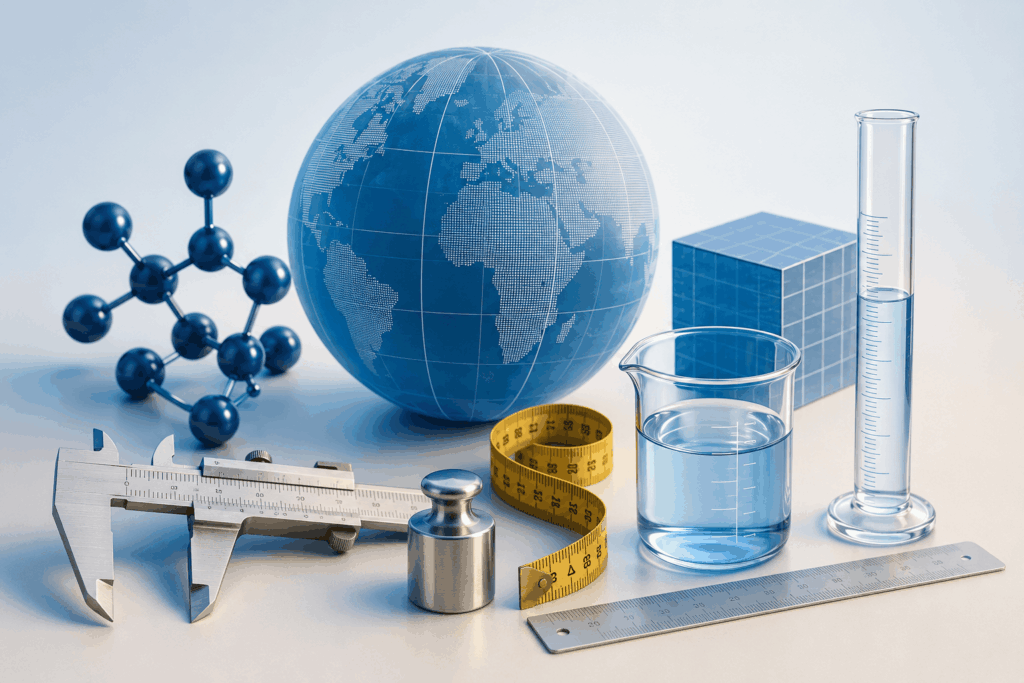
The metric system — officially known as the International System of Units (SI) — is the backbone of scientific measurement, engineering, and everyday calculation across almost every country in the world. Whether you’re converting milligrams to grams, calculating pressure in pascals, or trying to remember what “kilo” actually means in powers of ten, this guide brings every essential metric conversion, SI prefix, and derived unit together in one place.
This is a complete, bookmarkable reference — not just a list of numbers, but a practical guide to understanding why the metric system works the way it does.
What Is the Metric System (SI)?
The SI system is built on seven base units, each representing a fundamental physical quantity. Every other unit in science — from speed to electric charge to energy — is derived from these seven by multiplication or division.
| Base Quantity | SI Unit | Symbol |
|---|---|---|
| Length | metre | m |
| Mass | kilogram | kg |
| Time | second | s |
| Electric current | ampere | A |
| Thermodynamic temperature | kelvin | K |
| Amount of substance | mole | mol |
| Luminous intensity | candela | cd |
Everything else — square metres, newtons, joules, volts — is built from combinations of these seven.
The Complete SI Prefix Table
SI prefixes scale a base unit up or down by powers of ten. This is what turns a “metre” into a “kilometre” or a “gram” into a “microgram.” Below is the full official list, from the largest prefix to the smallest, as defined by the International Bureau of Weights and Measures (BIPM).
| Prefix | Symbol | Factor | Power of 10 |
|---|---|---|---|
| quetta | Q | 1,000,000,000,000,000,000,000,000,000,000 | 10³⁰ |
| ronna | R | 1,000,000,000,000,000,000,000,000,000 | 10²⁷ |
| yotta | Y | 1,000,000,000,000,000,000,000,000 | 10²⁴ |
| zetta | Z | 1,000,000,000,000,000,000,000 | 10²¹ |
| exa | E | 1,000,000,000,000,000,000 | 10¹⁸ |
| peta | P | 1,000,000,000,000,000 | 10¹⁵ |
| tera | T | 1,000,000,000,000 | 10¹² |
| giga | G | 1,000,000,000 | 10⁹ |
| mega | M | 1,000,000 | 10⁶ |
| kilo | k | 1,000 | 10³ |
| hecto | h | 100 | 10² |
| deca | da | 10 | 10¹ |
| — (base unit) | — | 1 | 10⁰ |
| deci | d | 0.1 | 10⁻¹ |
| centi | c | 0.01 | 10⁻² |
| milli | m | 0.001 | 10⁻³ |
| micro | µ | 0.000001 | 10⁻⁶ |
| nano | n | 0.000000001 | 10⁻⁹ |
| pico | p | 0.000000000001 | 10⁻¹² |
| femto | f | 0.000000000000001 | 10⁻¹⁵ |
| atto | a | 0.000000000000000001 | 10⁻¹⁸ |
| zepto | z | 0.000000000000000000001 | 10⁻²¹ |
| yocto | y | 0.000000000000000000000001 | 10⁻²⁴ |
| ronto | r | 0.000000000000000000000000001 | 10⁻²⁷ |
| quecto | q | 0.000000000000000000000000000001 | 10⁻³⁰ |
Tip: In daily and scientific use, you’ll mostly encounter kilo, hecto, deca, deci, centi, and milli — the rest appear in specialized fields like astrophysics (yotta, zetta) or nanotechnology (nano, pico, femto).
Metric Conversion Table: Length
| Unit | Symbol | Equivalent in Metres |
|---|---|---|
| Kilometre | km | 1,000 m |
| Hectometre | hm | 100 m |
| Decametre | dam | 10 m |
| Metre | m | 1 m |
| Decimetre | dm | 0.1 m |
| Centimetre | cm | 0.01 m |
| Millimetre | mm | 0.001 m |
| Micrometre | µm | 0.000001 m |
| Nanometre | nm | 0.000000001 m |
Quick conversions:
- 1 km = 1,000 m = 100,000 cm
- 1 m = 100 cm = 1,000 mm
- 1 cm = 10 mm
Metric Conversion Table: Mass
| Unit | Symbol | Equivalent in Grams |
|---|---|---|
| Tonne (metric ton) | t | 1,000,000 g |
| Kilogram | kg | 1,000 g |
| Hectogram | hg | 100 g |
| Decagram | dag | 10 g |
| Gram | g | 1 g |
| Decigram | dg | 0.1 g |
| Centigram | cg | 0.01 g |
| Milligram | mg | 0.001 g |
| Microgram | µg | 0.000001 g |
Quick conversions:
- 1 kg = 1,000 g
- 1 g = 1,000 mg
- 1 mg = 1,000 µg
Metric Conversion Table: Volume
| Unit | Symbol | Equivalent in Litres |
|---|---|---|
| Kilolitre | kL | 1,000 L |
| Hectolitre | hL | 100 L |
| Decalitre | daL | 10 L |
| Litre | L | 1 L |
| Decilitre | dL | 0.1 L |
| Centilitre | cL | 0.01 L |
| Millilitre | mL | 0.001 L |
| Microlitre | µL | 0.000001 L |
Quick conversions:
- 1 L = 1,000 mL
- 1 mL = 1 cm³ (this equivalence is extremely useful in chemistry and cooking)
- 1 kL = 1,000 L
Metric Conversion Table: Area
| Unit | Symbol | Equivalent in Square Metres |
|---|---|---|
| Square kilometre | km² | 1,000,000 m² |
| Hectare | ha | 10,000 m² |
| Are | a | 100 m² |
| Square metre | m² | 1 m² |
| Square centimetre | cm² | 0.0001 m² |
| Square millimetre | mm² | 0.000001 m² |
Temperature Conversion
Temperature doesn’t follow the prefix-multiplier pattern, since the Kelvin, Celsius, and Fahrenheit scales have different zero points.
| From | To | Formula |
|---|---|---|
| Celsius → Kelvin | K | °C + 273.15 |
| Kelvin → Celsius | °C | K − 273.15 |
| Celsius → Fahrenheit | °F | (°C × 9/5) + 32 |
| Fahrenheit → Celsius | °C | (°F − 32) × 5/9 |
SI Derived Units: The Complete Reference
Derived units describe physical quantities like force, pressure, and energy by combining base units. Several have special names; others are simply written as combinations.
| Quantity | SI Derived Unit | Symbol | In Base Units |
|---|---|---|---|
| Area | square metre | m² | m² |
| Volume | cubic metre | m³ | m³ |
| Speed / velocity | metre per second | m/s | m·s⁻¹ |
| Acceleration | metre per second squared | m/s² | m·s⁻² |
| Frequency | hertz | Hz | s⁻¹ |
| Force | newton | N | kg·m·s⁻² |
| Pressure / stress | pascal | Pa | N/m² = kg·m⁻¹·s⁻² |
| Energy / work / heat | joule | J | N·m = kg·m²·s⁻² |
| Power | watt | W | J/s = kg·m²·s⁻³ |
| Electric charge | coulomb | C | A·s |
| Electric potential (voltage) | volt | V | J/C = kg·m²·s⁻³·A⁻¹ |
| Electric resistance | ohm | Ω | V/A = kg·m²·s⁻³·A⁻² |
| Electric capacitance | farad | F | C/V |
| Magnetic flux | weber | Wb | V·s |
| Magnetic flux density | tesla | T | Wb/m² |
| Inductance | henry | H | Wb/A |
| Density | kilogram per cubic metre | kg/m³ | kg·m⁻³ |
| Catalytic activity | katal | kat | mol·s⁻¹ |
| Luminous flux | lumen | lm | cd·sr |
| Illuminance | lux | lx | lm/m² |
How to Convert Between Metric Units (Step by Step)
Converting within the metric system is just a matter of moving a decimal point — there’s no awkward multiplication like converting inches to feet.
Step 1: Identify the prefix of your starting unit and the prefix of your target unit. Step 2: Find the power-of-10 difference between them using the SI prefix table above. Step 3: Multiply or divide by that power of 10.
Example: Convert 4,500 milligrams to grams.
- Milli = 10⁻³, base gram = 10⁰
- Difference = 3 places
- 4,500 mg ÷ 1,000 = 4.5 g
Example: Convert 2.3 kilometres to centimetres.
- Kilo = 10³, centi = 10⁻²
- Difference = 5 places
- 2.3 km × 100,000 = 230,000 cm
Frequently Asked Questions
What are the 7 base SI units? The seven SI base units are the metre (length), kilogram (mass), second (time), ampere (electric current), kelvin (temperature), mole (amount of substance), and candela (luminous intensity).
What’s the difference between a base unit and a derived unit? Base units are independent, fundamental measurements. Derived units are built by combining base units — for example, speed (m/s) combines length and time, while force (newton) combines mass, length, and time.
Why does the metric system use powers of 10? Because it makes conversion simple and consistent. Moving from one prefix to another is always a matter of shifting a decimal point, unlike imperial units where conversion factors (12, 16, 5280, etc.) vary unit to unit.
Is “metric ton” the same as “tonne”? Yes. A metric ton (or tonne) equals 1,000 kilograms, distinct from the imperial/US “ton,” which equals roughly 907 kg (short ton) or 1,016 kg (long ton).
Which SI prefixes are most commonly used? For everyday and most scientific use: kilo, centi, milli, micro, and nano are by far the most common. Giga and mega appear frequently in computing and data contexts.
Final Thoughts
The metric system’s elegance comes from its consistency — once you understand the prefix table, you can convert almost anything without memorizing dozens of arbitrary ratios. Whether you’re a student, engineer, scientist, or just trying to convert a recipe measurement, this reference table covers the full scope of SI prefixes, base units, and derived units you’re likely to encounter.
Bookmark this page for quick reference, and feel free to use it alongside a digital converter tool for instant calculations.
Related Conversions You Might Need
Mastering the Metric System: Your Ultimate Reference to SI Units and Prefixes